
The short answer
- Children's classes follow the school calendar. In Catalonia this school year runs from 8 September 2026 to 21 June 2027. Fees come in over about ten months; rent is due in all twelve.
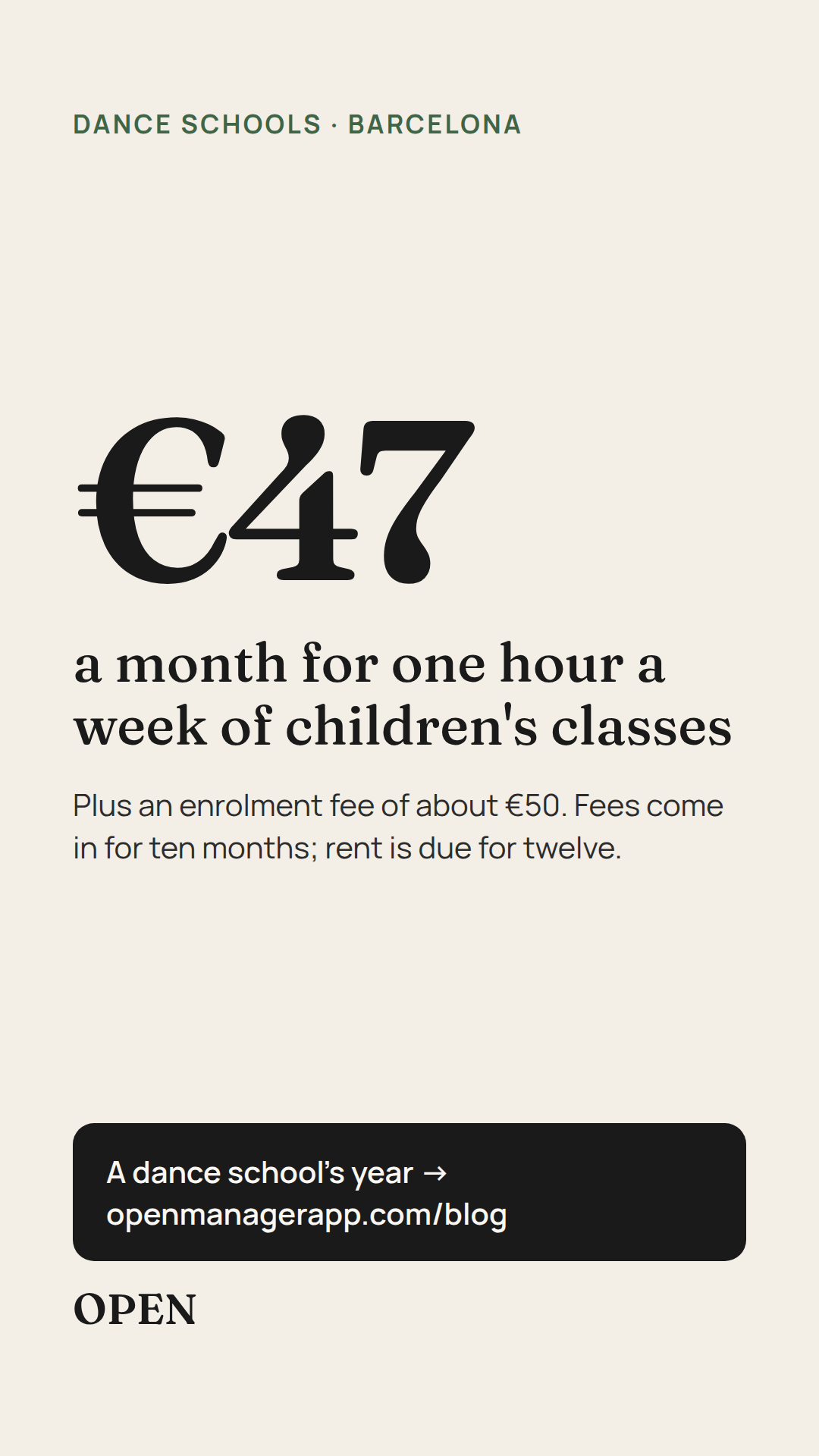
- A Barcelona dance school typically charges about €47 a month for one hour a week of children's classes, plus an enrolment fee of about €50. Almost all charge by the month, and one in three gives something back for paying the term or the year ahead.
- Dance is the most common organised activity for girls of school age in Barcelona. It's also the one most often given up: among girls who have stopped doing sport, dance is what they had most often been doing.
- In the yoga and Pilates studios in my data, August bookings fall 43% but money taken falls only 19%, because memberships keep renewing. A dance school that charges for ten months has no such cushion, so July and August have to be paid for during the year.
Sources: the Generalitat's school calendar, the Ajuntament de Barcelona's study of school-age sport, OCU, the price pages of Barcelona dance schools, and studios that use OPEN. How I worked it out is at the end.
In this article
I'm Nik and I make OPEN, booking and payment software for studios. Most of what I've written so far was about yoga and Pilates. Dance schools are a different business, and the reason fits in one line: their year starts in September and ends with a show in June.
I'd like to show you numbers from our own data, but too few dance schools use OPEN for me to publish their figures without someone recognising them. So this one rests on public sources and on what dance schools in and around Barcelona publish on their own websites.
September is when schools set up memberships, welcome new students and teachers, adjust the schedule and prepare their quarterly tax returns. The whole year depends on this one month, so there's no room for failure. And it's exactly when failures are most likely.
The dance school year in Barcelona: September to June
Children's classes follow the school calendar because parents do. In Catalonia the 2026-27 school year starts on 8 September 2026 and ends on 21 June 2027. The Christmas holidays run from 22 December to 7 January, and Easter from 20 to 29 March. Each town adds its own local holidays, and each school a few free days.
The dance schools that publish their calendar start one to three weeks after the schools and finish around the same week in June. Fees usually run from September to June.
| Month | What usually happens | Money |
|---|---|---|
| June, the year before | Re-enrolment for next year | Enrolment fees or a deposit to hold the place, where schools ask for one |
| September | Open days, trial classes, enrolment | Enrolment fees and the first month or term |
| October to December | Groups settle; Christmas break | Monthly fees; a short month in December |
| January to March | Show and costume details go to families; Easter break | Monthly fees; second term, if you charge by term |
| April to May | Rehearsals take over class time | Monthly fees; third term; costumes |
| June | The show, then the course ends | Last monthly fee |
| July | Intensives or a summer camp, or nothing | Only what summer brings |
| August | Closed | Nothing |
The difference from a yoga studio is the shape, not only the summer dip. A yoga studio loses people in summer and gets new ones in October and January. A children's dance school fills its groups when families plan the school year and, I suspect, keeps most of the same children until June. September is the month that decides the year.
Who comes: children, and mostly girls
The Ajuntament de Barcelona asks school-age children about their sport every few years. In the latest study (fieldwork in May and June 2022):
- Dance is the main organised activity among girls. One girl in five does an activity set to music.
- Across boys and girls it comes fifth: 10.6% of children who do organised sport do dance. In 2018 it was second, at 17%. The 2022 survey came straight after the pandemic, so I'd wait for the next one before calling that a trend.
- Among girls who used to do sport and have stopped, dance is the activity they had most often been doing (21%).
For Catalonia as a whole, an Aliança Educació 360 survey of the 2021-22 school year found that a quarter of children aged 6 to 15 do an artistic activity after school: a third of girls and one boy in six.
For a school that lives on children, the line about girls giving up is the one to think about. The study doesn't say at what age they stop. If I ran a school, I'd watch the groups where children change stage, the end of primary and the start of secondary, and give them something to aim at: their own piece in the show, a competition, a teen group with a name of its own.
Enrolment: the year is decided in September (and June)
Three dance schools in four charge an enrolment fee, about €50 in the middle of the range. Some charge it every year and some only once. Some charge returning students less, and several describe it as what reserves the child's place. Where schools say anything about refunds, the enrolment fee isn't refunded when someone leaves.
Two things help more than they cost:
- Re-enrol in June, not September. Families decide in the weeks around the show, when the child is excited about dancing. Some schools already use the enrolment fee, or a small fee in June, to hold next year's place. It turns "we'll see in September" into a yes, and it tells you in July how many groups you need.
- Count your groups by age, not only by style. A child who is seven this year will be eight next year. If one age group was full and the one above it half empty, you know where next year's gap is before anyone has enrolled.
Monthly fees or term fees
On the schools' own price pages, one hour a week of children's classes costs about €47 a month (most between €40 and €56), and two hours about €60 to €80. Adults pay about €50 for one hour a week. For comparison, OCU's latest back-to-school survey found families spend €70 a month per child on extracurricular activities at state schools, and €78 on average among those who use them.
Almost every school sets its price by the month. Four in ten also let families pay by term, by half-year or for the whole course, and one in three gives something back for it: a cheaper term, no enrolment fee, or a discount of 5% to 20%.
Here's what each way of charging does to your cash. An example to get a feel for it: 150 children paying €47 a month for ten months is €70,500 a year.
| How families pay | When the money arrives | What it does |
|---|---|---|
| Monthly, September to June | €7,050 in each of ten months | Easy for families. A child who leaves in February stops paying in February. |
| By term | About €23,500 in September, January and April | Cash up front, and children are less likely to leave mid-term. Harder for families, and you're holding money for classes you still owe. |
| The course in twelve payments | €5,875 a month, all year | Money in July and August too. Families need to understand they're paying for the course, not for the month. |
| The whole course up front, with a discount | Most of it in September | The most cash early, and the most to give back if someone leaves. |
The row I'd think about is the twelve payments. Rent, any loan and some salaries come every month of the year. If your fees come in ten, then from September to June you need to put aside a fifth of each month's fixed costs to get through July and August. That's what memberships do for a yoga studio: in the studios in my data, bookings fall 43% in August but money taken falls only 19%, because memberships keep renewing (details here).
Whatever you choose, write the leaving rules down before September. The schools that publish theirs ask for notice before a set day of the previous month, somewhere between the 15th and the 25th, or the next month is charged. Most schools that say how they collect use direct debit, often alongside cash in the first week of the month.
And ask your gestoría whether your classes carry VAT. Dance teaching can qualify for an education exemption depending on the course and who gives it, and that changes the price you need to charge.
The June show
The show is where the year ends, and for many families it's the reason for the year. On the websites, it's also where costs land on families: half the schools that mention their show say families pay for costumes, or for tickets. Hardly any publish an amount.
On your side, the costs are the venue or hall, the technician, costumes if you buy them, and the rehearsal weeks in May and June that replace normal classes. Ask the venue who pays the music rights for the show. If it's you, ask SGAE (and AGEDI/AIE, if you use recorded music) for a quote before you start selling tickets.
The show is also the school's best advert of the year. Every family brings grandparents, aunts and friends, and some of them have children who don't dance yet. Two cheap things make the most of it:
- Put next year's timetable and a QR code to re-enrol or book a trial class in the programme and at the door.
- Ask for photo and video consent at enrolment, in writing, not on the day. Under Spanish data protection law, children under 14 can't consent for themselves; their parents do (LOPDGDD, article 7). If you want to post the show on Instagram, you need that consent for every child who appears.
June is when you win next year's crowd. It's your chance to show the progress, inspire new students and get people talking about the school.
Summer: July and August
Fewer than a third of the schools mention anything for the summer. Those that do run July intensives, a summer camp for children that starts as soon as school ends, or regular classes into July. Some charge a small fee over the summer to keep a child's place and price for September.
A July programme does two things. It brings in money in a month that otherwise has none, and it keeps children in touch with the school, so September is a return rather than a new decision. If yours is closer to a holiday camp than a dance course, check with the Generalitat's youth department (Direcció General de Joventut) whether its rules for children's leisure activities apply. They cover summer camps, sports ones included.
One rule applies all year: anyone who teaches or helps with children's classes, paid or not, has to show a certificate from the Central Register of Sex Offenders before they start (Organic Law 8/2021, article 57). That includes the teenager who helps with the little ones on Saturday mornings.
How I worked it out
- School calendar. The Generalitat's calendar for 2026-27, set by Ordre EDF/66/2026.
- Children and dance. The Ajuntament de Barcelona's study of sport among school-age children (primary and secondary pupils in the city, fieldwork May to June 2022), and Aliança Educació 360's survey of after-school activities in Catalonia (children aged 6 to 15, 2021-22 school year).
- What families spend. OCU's back-to-school survey, published 26 August 2026: parents of children aged 3 to 18 across Spain.
- Dance schools' prices. On 27 October 2026 I read the price, enrolment and rules pages of independent dance schools in Barcelona and nearby towns, for children and adults, leaving out chains, conservatories and civic centres. Three in four publish their fees. Prices are list prices for one hour a week, per month; the figure given is the school in the middle. Each figure combines at least five schools, and no school is named.
- Yoga and Pilates in summer. Studios in and around Barcelona that use OPEN, October 2024 to September 2026, explained in opening a yoga studio in Barcelona. Each figure combines at least five studios.
- Dance schools on OPEN. Too few use it for their figures to be published, so there are none here.
- This is general information, not legal or tax advice. Check your own case with your gestoría.
Get the next article
One a month, for people who run a studio. No ads.
I make OPEN, booking and payment software for studios and schools, with monthly fees by direct debit. If you run a dance school and want to see how your year would look in it, book half an hour with me.