
The short answer
- Open in September or January. October brings 50 % more first-timers than a normal month; summer brings about 30 % fewer, and fewer of them come back.
- The first three months mislead: 42 % of first-timers come back within two months, but only 20 % are still coming in months four to six.
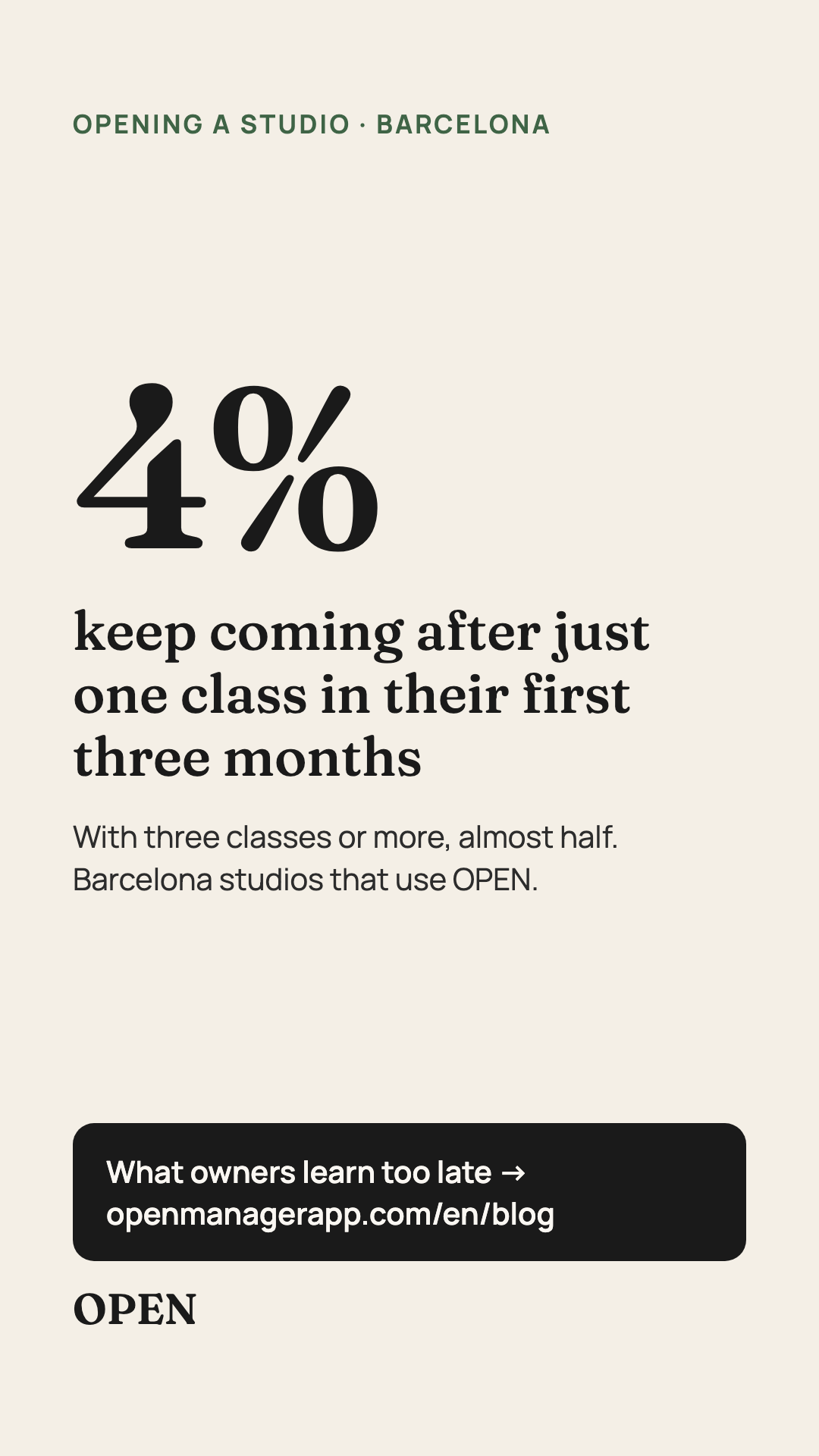
- The number that matters is the third class. Of people who take one class in their first three months, 4 % are still coming later. With three or more, almost half.
- A new class on the timetable usually has the same number of people at three months as in its first month. It rarely "takes off" on its own.
- Bookings fall 43 % in August, but money coming in falls only 19 %, because memberships keep renewing. Class packs bring cash earlier, and one class in five paid for in a pack is never used.
- Check the premises before you sign. Have a technician confirm the activity code, the opening procedure and what the space needs for noise, especially if there will be dancing or jumping.
Data from studios in and around Barcelona that use OPEN, October 2024 to September 2026. How I worked it out is at the end. General information checked on 23 October 2026, not legal or tax advice. Ask your gestoría or lawyer to review your case before signing or opening.
In this article
- The short answer
- When to open a yoga studio in Barcelona
- Why the first three months mislead
- The third class
- The timetable: fewer classes, judged early
- Memberships or class packs: what each does to your cash
- Cancellations: set the rule before you open
- The premises: before you sign
- Autónomo or SL, VAT and teachers
- Insurance and the paperwork people forget
I'm Nik and I make OPEN, the booking software several Barcelona studios use. In the previous post I looked at what a class really earns, how August drops and how many people come back. This one is for people who haven't opened yet, or opened recently.
I'm skipping the usual advice (find your niche, build a community, post on Instagram). What follows are things I've seen owners learn the hard way, and that can be measured. The premises, the paperwork and hiring teachers come at the end, with official links.
When to open a yoga studio in Barcelona
I counted how many people take their first class each month, against a normal month at the same studio (100 = the October to June average).
| Month | First-timers |
|---|---|
| September | 98 |
| October | 152 |
| November | 111 |
| December | 68 |
| January | 125 |
| February | 105 |
| March | 107 |
| April | 89 |
| May | 79 |
| June | 69 |
| July | 72 |
| August | 67 |
October brings half again as many first-timers as a normal month. January, a quarter more. June, July and August, around 30 % fewer.
The people who start in summer also come back less. Of those whose first class is between June and August, 27.5 % come back within two months. Start in September or October and it's 38 %. In January or February, 43 %.
So the calendar has two good windows. Opening in early September gives you October and November to fill classes. Opening in January catches the people who start with the new year. Open in May or June and your first months are the weakest of the year; with bookings down 43 % in August (more on that here), you can spend four months paying rent before you know whether the studio works.
My practical advice is to count backwards. To open in September, sign the lease in spring. The city paperwork itself is quick, but the works, the technician and the acoustic study take months (see below).
Why the first three months mislead
The first quarter usually feels better than it is, for three reasons.
First, new people aren't people who stay. At the typical studio, 42 % of first-timers come back within two months. Only 20 % are still coming in months four to six. If in month two you count "nearly half come back", you're counting twice what you'll actually have.
Second, the calendar. Open in September and October will bring half again as many first-timers as a normal month, then December a third fewer. Neither is your normal month. Don't average your first three months to plan the year.
Third, class packs. A 10-class pack is paid today and taught over the coming weeks or months. That's money you've collected for classes you still owe. Spend it on the fit-out and by the second quarter you'll have the classes but not the cash.
What I'd watch instead of total bookings: how many first-timers reach their third class, and how many memberships renew each month. Both are below.
The third class
This is the number that surprised me most. I looked at who is still coming in months four to six, by how many classes they took in their first three months:
| Classes in first 3 months | Still coming in months 4 to 6 |
|---|---|
| 1 | 4 % |
| 2 | 17 % |
| 3 or more | 48 % |
Going from one class to three makes staying about twelve times more likely. And only a third of first-timers get to a third class.
The window is short, too. Of people who come back within two months, 72 % do it within 14 days. If someone hasn't come back in two weeks, they probably won't.
A few more details that help design the first visit:
- People who pay for their first class with a single drop-in come back 25 % of the time. With a class pack, 75 %; with a membership, 70 %. Part of that is self-selection, since someone buying a pack on day one already meant to return. Still, it suggests the welcome offer should cover several classes, not one.
- People who start at the weekend come back less (35 %) than those who start on a weekday (44 %). Barcelona has lots of visitors, and many of them come on Saturdays.
- A small first class doesn't put people off. Those whose first class had three people or fewer came back as often or slightly more (42 %) than those who started in a class of eight or more (38 %). Don't cancel a quiet class out of worry about first impressions.
If I were opening tomorrow, my entry offer would be something like "3 classes in 14 days" at a price that doesn't hurt, plus a personal message after the first class suggesting the second. Plenty of Barcelona studios already sell a "trial week" or a three-class pack; the short deadline matters as much as the price.
The timetable: fewer classes, judged early
In the previous post I showed that Monday to Thursday carries 71 % of bookings and that between 1 and 5 pm there's hardly anyone (7 %). Almost one class in three had three people or fewer.
What's new here is what happens when a running studio adds a class to its timetable. I followed new classes (same day, same time, same class type) through their first months:
- One in five is dropped before week 12, usually after about seven weeks.
- The ones that stay have practically the same number of people in weeks 9 to 12 as in weeks 1 to 4. At six months, too.
- Only one in four grows by 25 % or more over those three months.
People say "give a new class three months". In this data, the first month already tells you most of it. Classes that ended up being dropped started at about 3 people on average; the ones that stayed, at nearly 6.
For a new studio that means two things. Open with fewer hours than you think you need and concentrate people: five classes of eight beat ten classes of four, especially if you pay teachers per class. And don't fill the middle of the day just because the room is free. Renting it by the hour to therapists or other teachers can earn more than a class of two.
Memberships or class packs: what each does to your cash
I covered what a class earns before: about €7.60 on a monthly membership and about €12.90 on a pack at the typical studio. Per class, the pack earns more. But cash behaves differently.
Memberships hold up through summer. Bookings drop 43 % in August against a normal month, but money coming in drops only 19 %. July is 16 % down. Memberships make the difference, because they keep renewing even when people come less.
| Month | Money taken | Bookings (previous post) |
|---|---|---|
| October | 104 | 110 |
| December | 92 | 83 |
| January | 118 | 103 |
| June | 93 | 85 |
| July | 84 | 85 |
| August | 81 | 57 |
| September | 102 | 94 |
They also leave slowly. Out of 100 monthly memberships, 86 renew the next month. Put the other way, you lose roughly one in seven each month. To grow, you need more new memberships than that. It's the most useful sum you can do every month.
Packs bring the cash earlier, and not all of it gets used. Of the classes paid for in packs of 5 to 20, 22 % were never used before the pack expired. Only half the packs were used up. That raises what you earn per class, but it also means some of your clients pay and don't come, and those people rarely buy again.
My reading: with memberships the first year is slower but calmer, and summer hurts less. With packs the cash arrives sooner and the price per class is better, but each month you start almost from zero. Most studios here mix both, and plans for one or two classes a week work well in between.
Two things to check with your gestoría: whether a pack can expire and after how long, and how VAT works on a pack paid today for classes in later months.
Cancellations: set the rule before you open
At the studios in my data, the median lets people cancel free of charge until 2 hours before class. Some set no limit and a few ask for 10 or 12 hours.
Given what the previous post found, that matters: 65 % of cancellations come in the last 12 hours and 35 % in the last two. With a two-hour rule, nearly all of those late cancellations are within the rules and the spot stays empty with no time for anyone else to take it. For reference, Urban Sports Club sets 12 hours by default for connected studios, and ClassPass follows the studio's window up to 12 hours.
On fining people who don't turn up, there's a 2025 academic study using data from a European sports subscription platform (Draganska and Yegoryan, EMAC 2025). The late-cancellation penalty cut late cancellations. The no-show fee didn't reduce no-shows and did increase membership cancellations.
What I'd do: a 12-hour window from day one (changing it later is harder than starting with it), written on the website and in the booking confirmation, with the class deducted from the pack or membership as the only penalty. No cash fines.
The premises: before you sign
This is where the most money gets lost, and where I have the least data. What follows comes from the published rules, with links. This whole section is for a gestoría or a technical architect to check before you act on it.
First, the prior consultation
In Barcelona you start with a prior consultation (consulta prèvia) on eActivitats. It gives you a "route sheet" saying whether the activity is allowed at that address, which procedure applies, which documents you need and whether the district's land-use plan requires a prior report. Do it with the exact address before signing anything. If you need an urban-planning compatibility report, the published fee is €184 (tax bylaw 3.3).
A notification, not a licence
A lot of older guides get this wrong. Since the 2024 change to the city's activities bylaw (annexes published in the Gaseta Municipal), a normal-sized gym or dance school doesn't apply for a licence: it files a notification (comunicació).
Before signing, I'd ask a technician to confirm the activity code, opening procedure and fee through eActivitats. Gyms and dance schools have different thresholds. A complete notification can allow opening once the required prior approvals are in place.
Noise, especially if you teach dance
Noise comes under Barcelona's environment bylaw. I'd check noise before signing the lease. Ask a technician what the studio needs for its classes, music and neighbours, especially if there will be dancing or jumping.
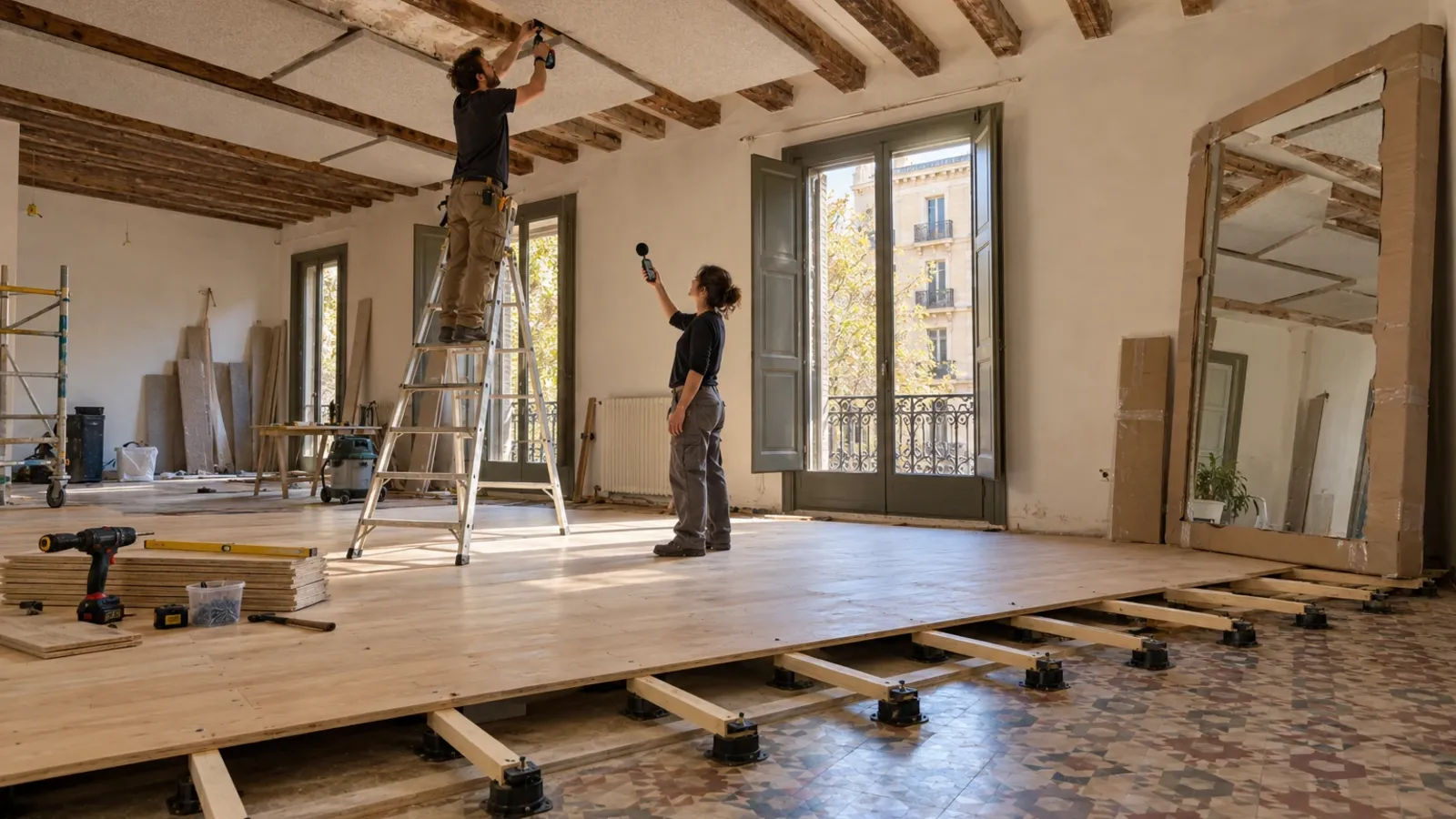
A class with loud music or jumping on the first floor of a residential building may need a floating floor and an insulated ceiling, which costs money and weeks.
Get a soundproofing quote with the space in front of you, before you sign.
The lease
On commercial premises almost everything is negotiable (art. 4.3 LAU). The legal deposit is two months' rent and the landlord has to lodge it with INCASÒL within two months; on top of that they can ask you for extra guarantees.
No law requires a rent-free period: if you want one while the works are going on, it has to be in the contract. And Barcelona Activa's rental guide recommends, for sports centres and gyms, a clause suspending the lease if the activity permit is refused. I'd ask for both, plus a shorter compulsory term for you than for the landlord.
One detail that surprises people in the first quarter: commercial rent normally carries 21 % VAT and 19 % withholding, whether the landlord is a person or a company. I'd ask the gestoría to check the withholding base, exceptions and tax filings before the first payment.
Autónomo or SL, VAT and teachers
Autónomo or limited company (SL)
As an autónomo (self-employed), the monthly payment depends on income and contribution base (Seguridad Social's 2026 table). Importass currently advertises an €80 reduced fee for eligible new entrants. I'd ask the gestoría to confirm eligibility and the full monthly payment, including MEI, before budgeting.
An SL can start with €1 of capital, with extra reserve and liquidation-liability rules below €3,000. The 15 % rate for qualifying new companies covers the first tax period with a positive taxable base and the next one. In exchange there's more accounting and more admin. Many people with one small studio start as autónomos and move to an SL when there are partners, a big lease or debts they don't want to sign for personally. I'd check the reserve and tax rules with the gestoría, especially when moving an existing business into an SL.
VAT on classes
Ordinary commercial yoga and pilates classes normally carry 21 % VAT. Dance teaching can qualify for an education exemption, depending on the course and provider. I'd ask the gestoría to check each activity, especially if the school mixes exempt and taxable classes.
If your prices include VAT, do the sum: of a €17 class, about €2.95 is VAT.
Invoicing
Verifactu requires invoicing software that meets its rules. As of 23 October 2026, the deadlines in law remain January 2027 for in-scope corporation-tax taxpayers and July 2027 for the others. Hacienda has announced a move to October 2028, pending legislation. I'd ask the gestoría which rules apply to the studio.
Teachers and "falso autónomo"
It's common to pay teachers per class against a self-employed invoice. I'd have the gestoría check how teachers actually work before choosing contracts or invoices: Spain's Workers' Statute looks at the real relationship, and several clients don't settle employment status.
If the labour inspectorate treats a teacher as an employee, you pay what was missing, and not registering a worker is a serious infraction of €3,750 to €12,000 for each person.
Part-time or "fijo discontinuo" contracts need to fit the work, and the applicable agreement sets pay alongside the minimum wage (SMI). Professional invoices generally carry 15 % withholding; qualifying starters can use 7 % in the start year and the next two after notifying the payer.
One number that helps choose the model: if one class in three has three people or fewer, paying per class means those classes cost you as much as full ones. Some studios combine a fixed fee with a per-student part. What's legal, and fair to the teacher, is for the gestoría to work out with you.
Insurance and the paperwork people forget
- Civil liability. Catalonia sets organiser liability cover at a minimum of €600,000 per claim and €150,000 per victim (Decree 58/2010). I'd ask the insurer to cover the studio's actual activities, and check each teacher's professional cover and ROPEC or professional-college registration. Yoga and pilates aren't automatically outside these rules.
- Music. If you use recorded music in class, I'd ask for a current licence quote covering the repertoire and how the studio uses it. Check authors' rights through SGAE and performers' and producers' rights through AGEDI/AIE, including what each payment covers.
- Health data. Injury and pregnancy forms collect health data. I'd have whoever advises the studio on privacy check the legal basis and explicit consent or other permitted exception (GDPR). Collect only what's needed, explain the use, record the processing, restrict access and set a deletion date.
- Written rules. Cancellations, pack expiry, cancelling a membership and what happens in August. Written before you open, on the website, and accepted at purchase.
For all of this, Barcelona Activa's permits service helps with city permits for free, and Barcelona Activa's start-up service advises people starting a business.
How I worked it out
The data comes from the bookings, attendance and sales of several studios in and around Barcelona that use OPEN, from October 2024 to September 2026. Each figure is the median across studios (the studio in the middle) and combines at least five. No studio is named or identifiable.
- I can't measure how a brand-new studio grows: almost every studio arrives at OPEN with its clients, so its first month with us isn't its first month open. Everything here comes from studios that were already running.
- A "first-timer" is someone taking their first class at the studio, excluding platform clients and each studio's first three months on OPEN. "Still coming" means they took a class between day 90 and day 179 after their first.
- A "new class" is a day, time and class type that first appears once the studio has been on OPEN for at least six months, and that ran at least four times in its first six weeks.
- Money taken is what was sold each month in drop-ins, packs and memberships, excluding workshops, trainings, private classes and platforms. A "normal month" is each studio's October to June average.
- Packs are those bought between October 2024 and September 2025 that have since expired. A membership "renews" if the same person starts another within 35 days of the previous one ending.
- Online classes and events are not included.
Get the next article
One a month, for people who run a studio. No ads.
I make OPEN, the software this data comes from. If you're opening a studio and want to go through these numbers for your case, book half an hour with me.