
The short answer
- About half of the yoga, Pilates and training studios in Barcelona city have no online booking on their website. People book by WhatsApp, phone, email or Instagram. In the towns around the city it's about two in three.
- Where people can do it themselves, one in four pass purchases happens between 9 pm and 9 am, and another quarter at the weekend.
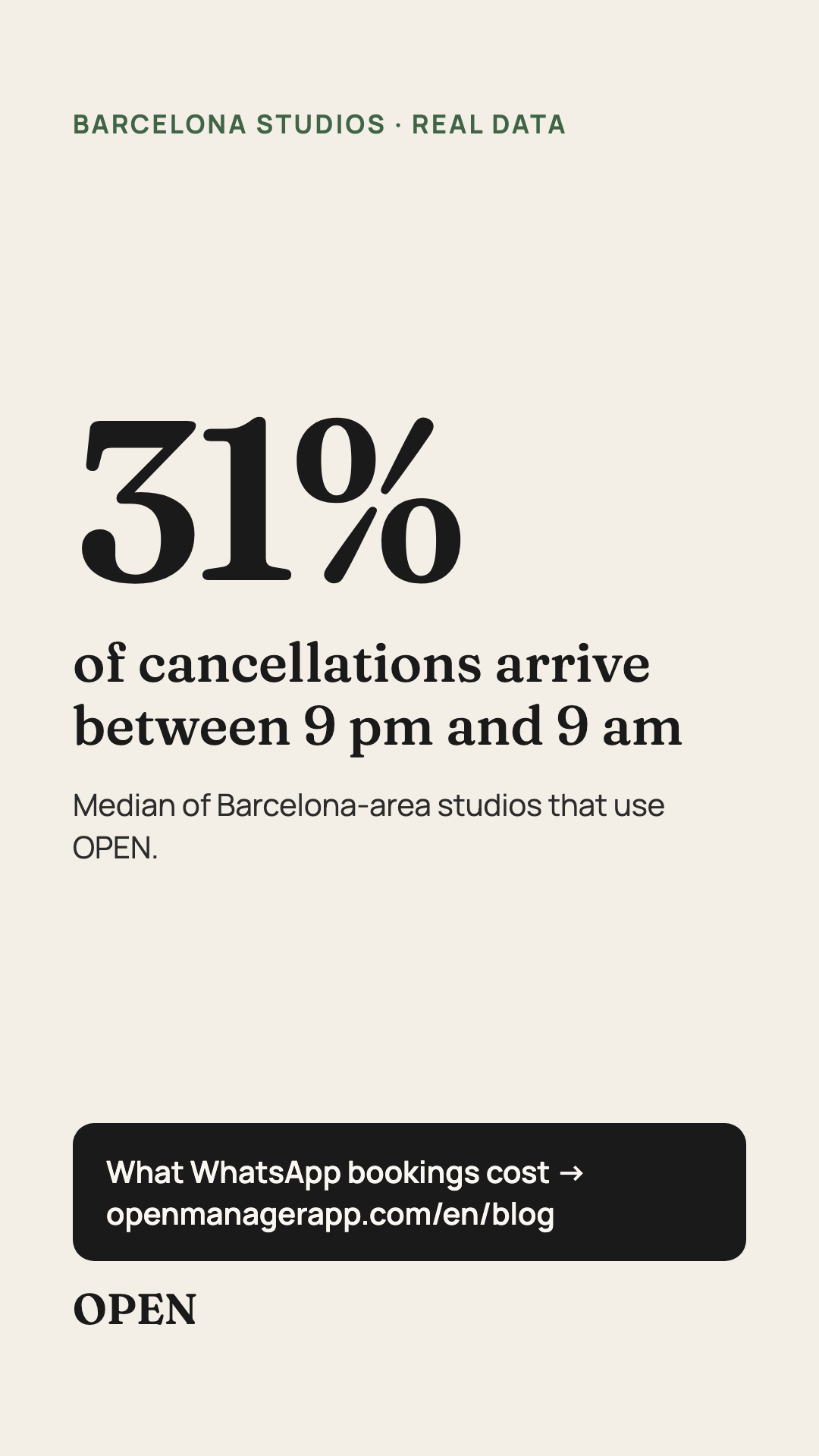
- Almost a third of cancellations arrive between 9 pm and 9 am. On WhatsApp, each one is a message someone has to read and write down.
- One booking in five gets cancelled, and two in three of those cancellations come in the last 12 hours.
Data from Barcelona studios' public websites and from studios in the area that use OPEN. How I worked it out is at the end.
In this article
I'm Nik and I make OPEN, booking software for studios. Plenty of Barcelona studios run everything through WhatsApp, and plenty of them are happy with it. What almost nobody has added up is what it costs them, because it never shows up on an invoice.
So I went and looked. I went through the websites of more than 400 yoga, Pilates and training studios in Barcelona city, and put that next to the data from studios in the area that already take bookings online with OPEN.
How many Barcelona studios run on WhatsApp bookings
In Barcelona city, about half of the studios have no way to book online on their website: no calendar and no link to an app. Of those, half put a WhatsApp button on the site and nearly all list a mobile number.
It varies a little by type of studio:
| Type of studio (Barcelona city) | No online booking on the website |
|---|---|
| Yoga | 6 in 10 |
| Pilates | About half |
| Training and boutique studios | 6 in 10 |
| Mixed studios (yoga, Pilates, barre) | 1 in 4 |
And by neighbourhood. In the Eixample, Gràcia, Sant Martí and Ciutat Vella it's around half. In more residential areas like Sant Andreu or Les Corts it's three in four. Outside the city, in the metropolitan area, about two in three.
That makes sense. According to the CNMC household panel, 94.6% of internet users in Spain use WhatsApp regularly. Your clients have it open all day, and for a small studio it's the easiest thing there is.
What WhatsApp bookings cost
Hours you don't see
Every WhatsApp booking is several messages: the question, the answer, sometimes "what about Thursday?", and then writing it down somewhere. Every cancellation, the same. In the studios in my data, one booking in five gets cancelled.
An example to get a feel for it. If your studio takes 150 bookings a week, that's around 30 cancellations, and about 20 of them arrive in the last 12 hours, when the spot could still be filled if someone found out in time.
I don't have a reliable figure for how many minutes each message takes, and I'm not going to make one up. What I'd suggest is counting the booking messages in one normal week before you decide anything.
Nights and weekends

When people can book or cancel on their own, they don't do it in office hours. In the studios in the area that use OPEN:
On WhatsApp, all of that lands on somebody's phone. Either you answer at 11 at night or you leave it for the morning. If you leave it, the person who wanted to buy a pass at 10 on a Sunday night may not write again, and the spot that opened up overnight stays empty in the 8 am class.
People who don't turn up
In the studios that take attendance, 8.5% of bookings don't show up. That happens with online booking too, so WhatsApp isn't to blame here. What changes is the reminder.
A Cochrane review of trials with medical appointments found that a text reminder raises attendance compared with no reminder, and works as well as a phone call. These aren't yoga classes, but the logic is the same. On WhatsApp, you send that reminder yourself, one by one.
And if you're thinking of charging people who don't come, be careful. A 2025 study of a European sports subscription platform found that late-cancellation fees did change behaviour, but no-show fees didn't reduce no-shows, and membership cancellations went up.
The spot that was given twice
I can't measure this one, but it's easy to see how it happens. Two spots left, you say yes to two people on WhatsApp and a third on Instagram, and all three turn up. Or someone cancels, you had a person waiting for that spot, and you can't remember who it was. The waiting list lives in your head or on a piece of paper.
Taking payments by hand
With WhatsApp, payment usually happens somewhere else: cash, Bizum or a bank transfer, plus a notebook or spreadsheet with how many classes each person has left. The tiring part is remembering who has paid, whose pass expires when, and who has done three classes without paying.
You don't need online payments to stop chasing money, though. According to the Banco de España, cash is still the main way to pay in shops for 59% of people, and between individuals 33% mostly use Bizum. In the typical studio in my data, fewer than one pass in ten is paid online, even though the bookings are online. What changes is that the software keeps count of the classes.
When WhatsApp bookings still work well

There are studios where I wouldn't change a thing. If this sounds like you, you're probably fine as you are:
- You run fixed groups: the same people come on the same day at the same time all term, and you only handle the odd change.
- You teach every class yourself and have a small number of students. WhatsApp is faster than any software there.
- You have hardly any tourists or drop-ins, so nobody messages you at midnight from a hotel.
- You like talking to your students, and for them the message is part of the relationship. That's worth money, and I wouldn't take it away.
If you stay with WhatsApp, some things help. WhatsApp Business has quick replies, an away message and labels to keep bookings apart from questions. A clear cancellation rule (say, 12 hours before) written on your profile saves a lot of arguments. And a reminder the day before, even sent by hand, helps more than you'd think.
If you're thinking of switching
You don't have to give up WhatsApp. What usually works is keeping it for conversation and letting the system handle the booking, the cancellation and the class count. To keep it simple, check three things before you choose software: that students can cancel on their own, that the waiting list notifies people by itself when a spot opens, and that you can keep taking payments the way you do now.
Start with one class or one week, not the whole studio. And tell your students on the same WhatsApp, because that's where they read you.
How I worked it out
- How many studios book by WhatsApp. On 21 October 2026 I checked the public websites of the yoga, Pilates, barre and training studios in Barcelona and its metropolitan area listed on Google Maps, leaving out chains and municipal gyms. On each site I looked at the home page and up to six schedule, price or booking pages, and noted whether there was a calendar, button or link to book online. Studios with no website of their own (Instagram only, or nothing) and sites that didn't load are left out of the share. Studios already on OPEN aren't included. When I checked a random sample by hand, the scan had missed a booking tool on fewer than one site in ten, so the real figure may be a little lower. That's why I say "about half".
- Timing of purchases and cancellations. Studios in and around Barcelona that use OPEN, October 2025 to September 2026. Passes bought and paid online by the person themselves (automatic renewals excluded) and cancellations made before the class, in Madrid time. Passes paid online are the share of passes sold that year that the person paid online. Each figure is the median across studios and combines at least five. There are no names and nothing that would identify a studio.
- Cancellations and no-shows. These are the figures from my previous article, with the same method.
- I don't have data on how a studio was doing before it started taking bookings online, so I don't compare before and after.
Get the next article
One a month, for people who run a studio. No ads.
I make OPEN, booking software for studios. If you'd like to see how yours would look without giving up WhatsApp, book half an hour with me.