
The short answer
- A new studio reformer costs €3,000 to €4,200 including VAT for the usual models from brands that sell in Spain. Second-hand, half the listings ask €2,000 or less.
- Plan on about 7 m² per machine, plus reception, changing room and toilet.
- Shops in Barcelona pay €19.57 per m² a month on average, from €14 in Horta-Guinardó to €28 in Ciutat Vella.
- In job ads, a reformer teacher earns €14 to €30 an hour, about €21 in the middle.
- On a two-classes-a-week membership, each spot brings in about €17.50 a class (VAT included, counting 8 classes a month). The list price of a drop-in is €30.
- In the worked example below, the first two people in each class pay the teacher and the third pays the rent.
Public sources, linked in each section and read on 23 October 2026. The calculation near the end is an example with stated assumptions, not data. General information checked on 23 October 2026, not legal or tax advice. Ask your gestoría or lawyer to review your case before signing or opening.
In this article
I'm Nik and I make OPEN, the booking software a number of studios in Barcelona use. More and more people ask me about reformer pilates. Some want to open a studio, others want to fit four machines into a yoga room. It nearly always comes down to the same thing: how many classes you need to fill to pay for it all.
I wanted to answer with data from studios that use OPEN, like in the first post. But I have too few reformer studios in Barcelona with clean data, so this time everything comes from public sources: manufacturers' price lists, the city council, the official gazette, job ads and studios' own websites.
The machines: new or second-hand
The reformer is the big cost and the one people notice. These are the list prices brands selling in Spain publish, VAT included unless stated otherwise:
| Brand | Studio reformer, no tower | With tower |
|---|---|---|
| Elina Pilates (Navarra) | €2,892 to €6,038 | €3,812 to €6,643 |
| Align-Pilates | €2,389 to €4,355 | |
| Peak Pilates | €3,080 to €6,175 | €6,285 |
| BASI Systems | €4,900 to €8,990 before VAT |
For example, Elina's Mentor costs €3,617.90, Align's C8-Pro €3,084.29 and Peak's MVe €4,170. On the pages I checked, Balanced Body and Merrithew (STOTT) didn't show euro prices. On their US sites, the Balanced Body Allegro 2 is $4,050 and the Merrithew SPX Max $3,949.
Two things to watch. Delivery is usually to the kerb, and assembly isn't included (Elina and Peak both say so in their terms). And for any model, including the folding "home" reformers at €1,200 to €1,800, I'd check the manufacturer's commercial-use rating and warranty terms.
For second-hand, I looked at what people ask on Wallapop and Milanuncios. A reformer without a tower goes for €1,000 to €3,450, and half the listings ask €2,000 or less. Balanced Body machines ask more, around €3,000. With a tower, €2,500 to €6,600. These are asking prices, not sale prices. For a used machine, I'd check the seller, service history, springs, ropes and carriage wheels before paying.
How much space a reformer needs
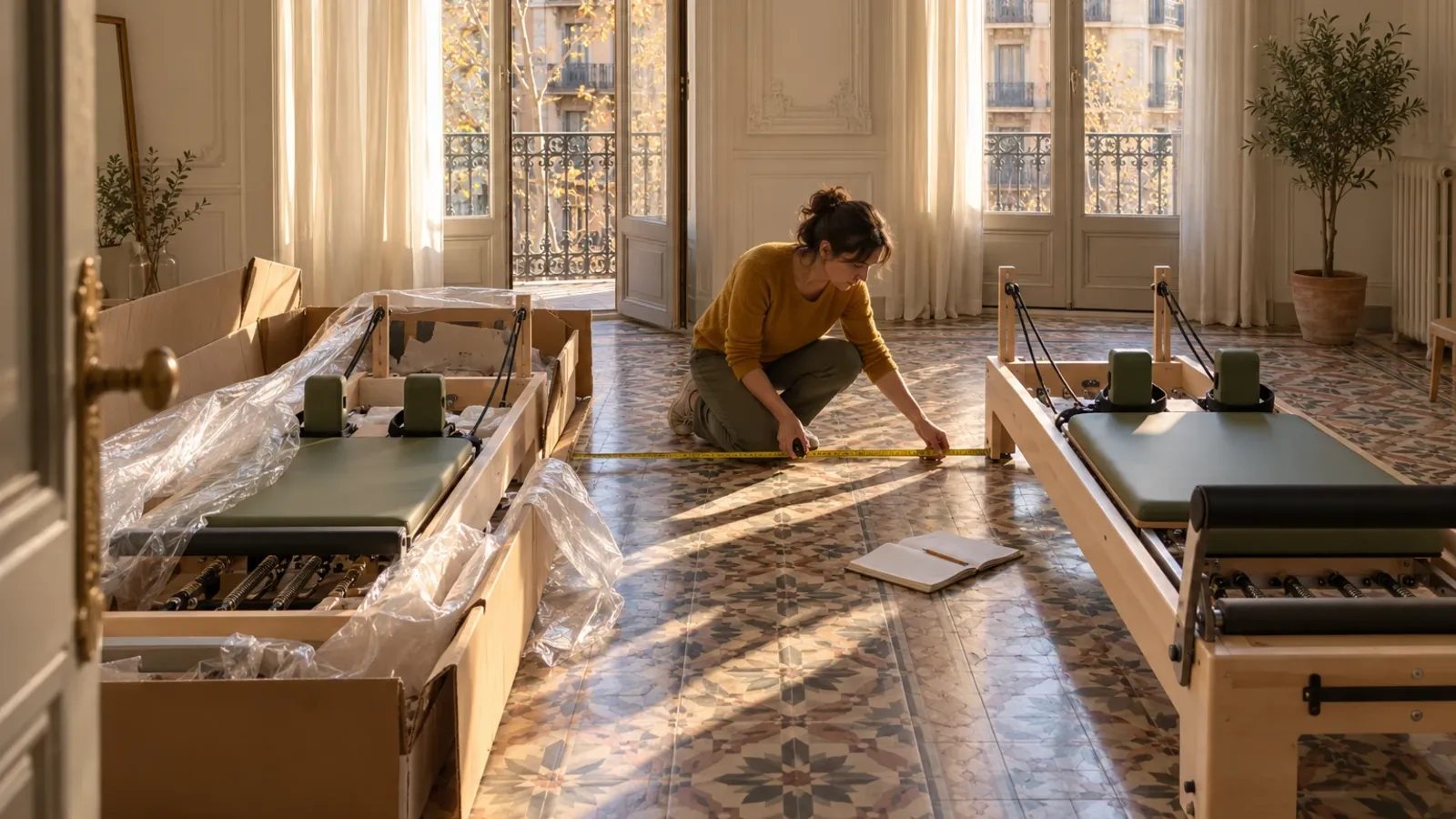
A reformer is 2.35 to 2.62 metres long and 66 to 86 cm wide, depending on the brand. No manufacturer gives a spacing rule. The only one I found comes from an Australian equipment seller, Your Reformer: one reformer per 7 m² of room, 75 cm to a metre from the wall.
By that rule, 8 machines take about 56 m² of room. Add reception, a changing room and a toilet and you're at about 100 m². 12 machines need about 85 m² for the room alone.
Two more things to check before you sign:
- The ceiling. Merrithew asks for 2.48 m for standing work on the machine with arms overhead (SPX Max spec sheet). Mezzanines and low basements won't work.
- The floor. Spain's building code designs homes for 2 kN/m² and gyms for 5 kN/m². A machine weighs 58 to 90 kg, plus the person on it. A first-floor Eixample flat can be beautiful, but ask an engineer before you fill it with machines.
Rent for a reformer pilates studio in Barcelona, by district
Every year the city council asks the city's shops how much rent they pay. These are current contracts (not asking prices) and they're retail, not gyms, but it's the only public figure by district. The 2025 numbers are on the council's commerce observatory.
I've added the share of the city's pilates studios in each district. It comes from our own list of Barcelona studios, built from Google Maps in October 2026 (independent studios, no chains or clinics).
| District | € per m² a month | A 100 m² space | Share of the city's pilates studios |
|---|---|---|---|
| Ciutat Vella | €28.31 | €2,831 | 3 % |
| Sarrià-Sant Gervasi | €26.32 | €2,632 | 20 % |
| Les Corts | €21.05 | €2,105 | 5 % |
| Gràcia | €20.10 | €2,010 | 13 % |
| Eixample | €18.83 | €1,883 | 25 % |
| Sants-Montjuïc | €17.62 | €1,762 | 6 % |
| Sant Martí | €16.00 | €1,600 | 16 % |
| Sant Andreu | €15.58 | €1,558 | 6 % |
| Nou Barris | €14.31 | €1,431 | 1 % |
| Horta-Guinardó | €14.16 | €1,416 | 3 % |
| Barcelona | €19.57 | €1,957 |
Three in four pilates studios are in four districts: Eixample, Sarrià-Sant Gervasi, Sant Martí and Gràcia. In Sarrià-Sant Gervasi and Les Corts, more than half the studios we found teach pilates. And Sarrià-Sant Gervasi is the second most expensive district. So where pilates is most concentrated, rent is among the highest in the city.
To compare with asking prices today: a market report by Catalonia's estate agents (API) puts listed premises in Barcelona at €18.3 per m² a month in the second quarter of 2026. In the 100 to 180 m² listings I looked at, rent ran from about €1,300 to €3,600 a month, nearly always plus VAT.
What you pay up front counts too. The statutory deposit for commercial premises is two months' rent. Some of the listings I looked at also asked for two more months as a guarantee, or a fee of 10 % of a year's rent. Commercial rent normally carries 21 % VAT and 19 % withholding, whether the landlord is a person or a company. I'd ask the gestoría to check the withholding base, exceptions and tax filings before the first payment.
Before signing, I'd have a lawyer check the commercial lease, especially the deposit, extra guarantees, insurance clauses and costs charged to the tenant.
Teachers
The usual agreement is the national gym agreement. The 2026 full-time minimum wage (SMI) is €17,094 a year. It's above the 2025 base salary for the agreement's instructor categories, but I'd ask the gestoría to work out the current category, supplements and annual minimum before budgeting a teacher's pay.
What people actually earn shows up in job ads. In the reformer teacher ads I found across Spain, the hourly rate runs from €14 to €30, about €21 in the middle. Almost no Barcelona ad states the pay.
If the teacher is employed, employer contributions on a standard indefinite gym contract are about 33.65 % of the contribution base in 2026; I'd confirm the payroll sum with the gestoría. If they're freelance, I'd have the gestoría check how they actually work before choosing contracts or invoices: having several clients doesn't settle employment status.
One thing in Catalan law that many people don't know. Llei 3/2008 covers teaching in gyms and similar centres by the work done, not the studio's name, and asks for a recognised qualification (for example, a sports science degree or the higher vocational diploma in physical activities). I'd check each teacher's accepted qualification or recognition route and their ROPEC or professional-college registration. A private pilates certificate alone doesn't settle this. Experience needs formal recognition where it applies, and professional liability cover needs its own check, especially for freelancers.
If you'll teach yourself, reformer training costs about €1,300 to €1,900 on the Barcelona courses I found, and up to €4,000 for Balanced Body's full programme.
What clients pay
On 22 October 2026 I looked at the prices Barcelona reformer studios publish on their websites. These are list prices (what's advertised), not what studios end up collecting:
| Plan | List price (median) | Per class |
|---|---|---|
| Two classes a week | €140 a month | €17.50 |
| 10-class pack | €199.50 | €19.95 |
| One class a week | €86.50 a month | €21.60 |
| Unlimited | €207 a month | |
| Drop-in | €30 | €30 |
The per-class figure for two classes a week counts 8 classes a month. Over a full year, two a week averages about 8.7 classes a month, which brings it to about €16.
In studios that sell both, a reformer class is advertised at 1.7 to 2 times the price of a mat pilates class. And many studios sell 4 or 8 classes a month rather than unlimited.
I wouldn't plan around the €30 drop-in. In the yoga studios from the first post, what a class really earned came out a third below the drop-in price. Membership discounts and trial offers can bring the average below the drop-in price. Unused prepaid classes raise money received per class attended. I can't measure it for reformer yet, but I see no reason it would be different.
Remember too that the client's price already includes VAT. Of that €17.50, the studio keeps €14.46.
Example: how many full classes pay for the room
This is an example with assumptions, not data from any studio.
The assumptions:
- 100 m² in Eixample at €18.83 per m²: €1,883 a month plus VAT.
- 8 new reformers at about €3,000 each before VAT: €23,920. Second-hand, about €16,000.
- Each spot brings in €14.46 before VAT (the two-classes-a-week plan, counting 8 classes a month).
- The teacher earns €21 gross an hour on a contract: about €28 per class with social security.
That gives you:
- The first two people pay the teacher: €28 divided by €14.46 is 1.9 spots.
- A full class of 8 leaves €88 after the teacher. To cover the rent alone you need about 22 full classes a month, 5 a week.
- But classes aren't full. The only public figure I found is from Mariana Tek, a North American booking platform: its pilates classes fill 65 % on average. At an average of 5.2 people out of 8, each class leaves €47 and you need about 9 classes a week to cover the rent.
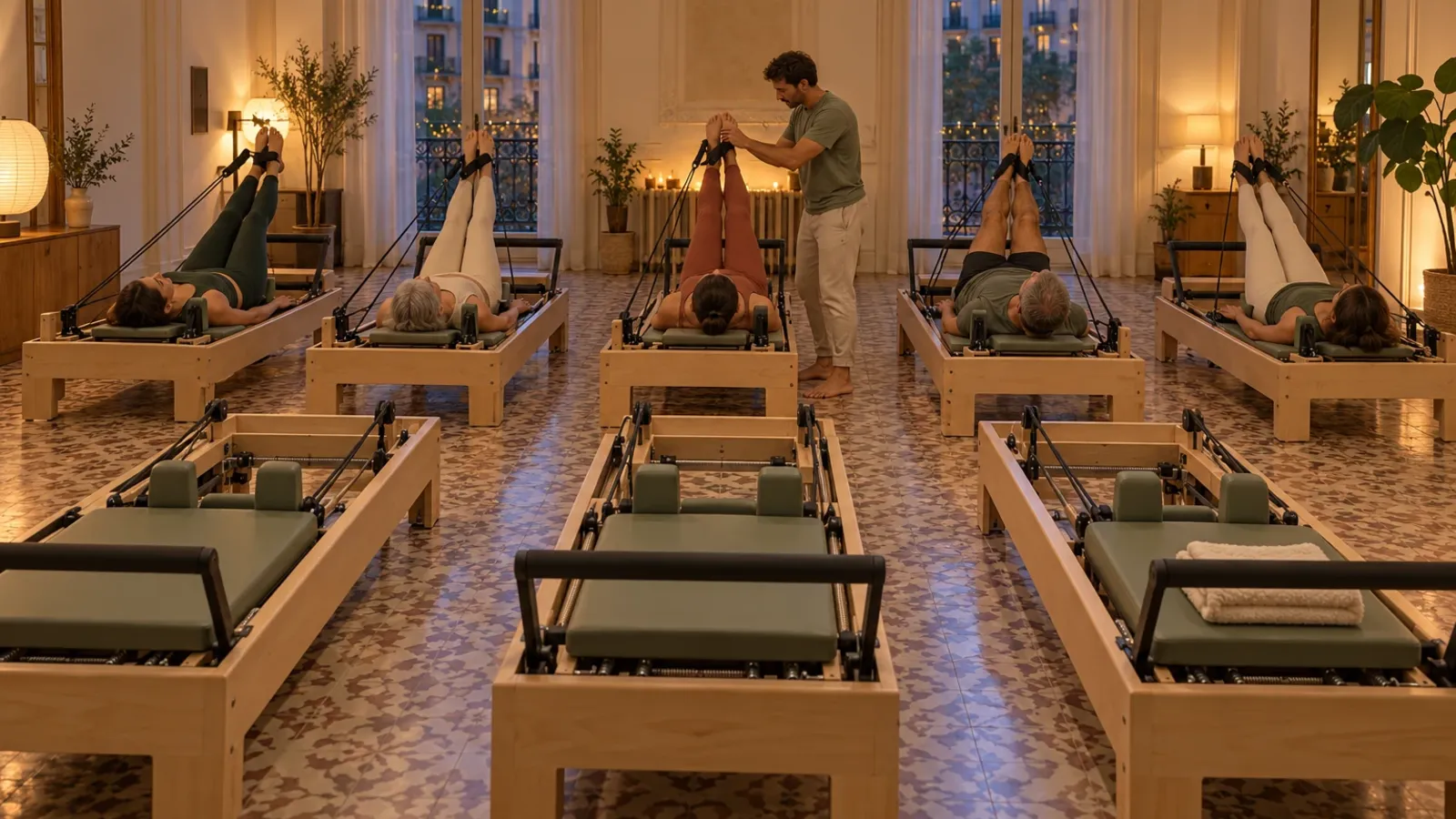
- With 25 classes a week at that 65 %, rent works out at €17 a class, just over one spot. After teacher and rent, about €3,200 a month is left. New machines would pay for themselves in about 7 months, second-hand ones in 5.
Seven months sounds quick, but the example leaves a lot out: the fit-out and the technical paperwork (above 120 m², the council asks for a technical project and certificate), the deposit, electricity, cleaning, insurance, the gestoría, booking software, advertising, the first months with a half-empty room, and your own salary. August weighs on it too: in the yoga studios in our data, August drops to 57 bookings for every 100 in a normal month.
So I'd go by a simpler rule. Work out how many people each class needs to cover the teacher and the rent (in the example, about 3 out of 8). Everything above that pays for the rest. If your timetable has a lot of classes with 3 or 4 people, the machines aren't the problem.
How I worked it out
- Machine prices: list prices each brand publishes on its European or Spanish site, read on 23 October 2026. Second-hand: asking prices on Wallapop and Milanuncios the same day.
- Rent: Barcelona City Council's annual retail survey, 2025 (rent shops say they pay on current contracts).
- Where the studios are: our list of independent Barcelona studios, built from Google Maps and studio websites in October 2026. It counts every studio that teaches pilates, with or without machines.
- Client prices: websites of reformer studios in Barcelona city, read on 22 October 2026. Median of the published prices, intro offers left out.
- Pay: the gym agreement and minimum wage from the official gazette, and public job ads from October 2026.
- OPEN's own figures (August, real revenue per class) come from yoga studios in Barcelona, as in the first post, and each figure pools at least five studios. I don't have enough reformer studios yet.
Get the next article
One a month, for people who run a studio. No ads.
I make OPEN, booking and membership software for studios. If you're setting up a reformer studio and want to go through these numbers for your case, book half an hour with me.