
The short answer
- The 17 towns have 1.3 independent yoga, Pilates and training studios per 10,000 residents. That's one for every 7,800 people.
- El Masnou (4.9), Sitges (4.6) and Molins de Rei (4.0) are as crowded as Gràcia or Sarrià-Sant Gervasi. Between them they have 16% of the studios and 4% of the residents.
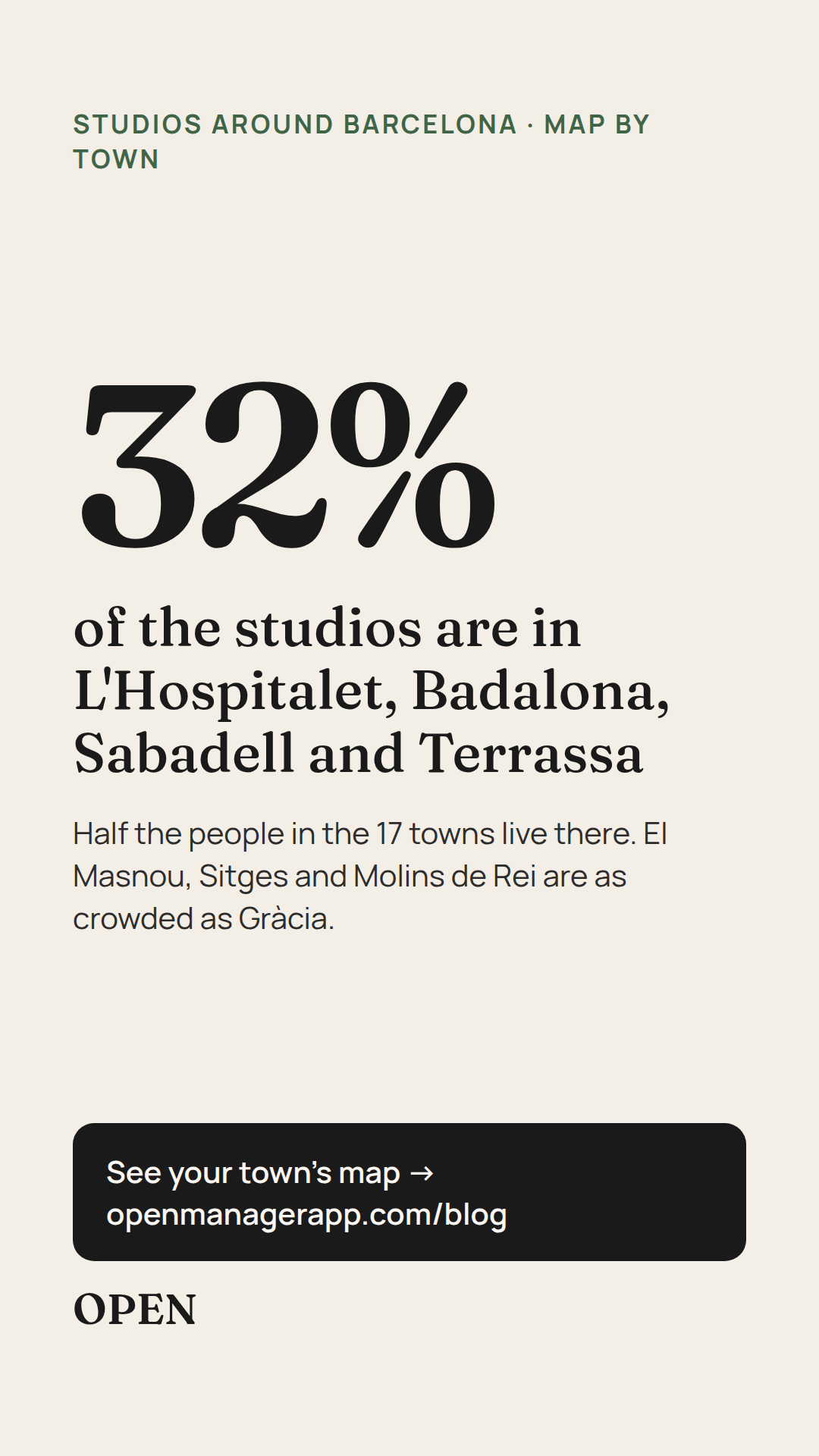
- L'Hospitalet, Badalona, Sabadell and Terrassa are home to half the residents and only 32% of the studios. In L'Hospitalet there's one studio for every 19,500 residents.
- Where income is above the Catalan average there are nearly three times as many studios per resident. And outside the city more studios do both yoga and Pilates: 12%, against 7% in Barcelona.
Studios: public Google Maps listings, October 2026, no chains. Residents and income: Idescat. How I worked it out is at the end.
In this article
The Barcelona map by district stopped at the city limits. This is part two: the yoga and Pilates studios around Barcelona, in 17 towns from Vilanova i la Geltrú to Mataró, counted per resident.
That's nearly 250 independent studios listed on Google Maps, with no chains or gyms. As with the Barcelona map, no studio is named.
Time works differently outside the city. People plan ahead, they lose less time in traffic and they tend to build stronger social circles. A client you win here often stays for years.
How many yoga and Pilates studios there are around Barcelona
As in Barcelona, I count studios per 10,000 residents, because L'Hospitalet has nearly twelve times as many residents as El Masnou. Esplugues and Santa Coloma are combined because each has fewer than ten studios.
| Town | Studios per 10,000 residents | One studio per | Disposable income per resident (2023) |
|---|---|---|---|
| El Masnou | 4.9 | 2,100 residents | €23,900 |
| Sitges | 4.6 | 2,200 residents | €24,800 |
| Molins de Rei | 4.0 | 2,500 residents | €23,000 |
| Granollers | 2.8 | 3,600 residents | €20,600 |
| Gavà | 2.5 | 4,000 residents | €21,900 |
| Sant Cugat del Vallès | 2.5 | 4,100 residents | €30,400 |
| Castelldefels | 2.0 | 5,000 residents | €22,300 |
| Vilanova i la Geltrú | 1.7 | 5,900 residents | €20,600 |
| Sant Boi de Llobregat | 1.3 | 7,800 residents | €19,500 |
| Badalona | 1.2 | 8,200 residents | €19,100 |
| Cornellà de Llobregat | 1.1 | 9,200 residents | €19,200 |
| Mataró | 0.9 | 10,900 residents | €18,500 |
| Esplugues and Santa Coloma | 0.8 | 12,300 residents | €18,400 |
| Sabadell | 0.8 | 12,500 residents | €20,300 |
| Terrassa | 0.8 | 12,900 residents | €19,900 |
| L'Hospitalet de Llobregat | 0.5 | 19,500 residents | €17,600 |
| The 17 towns | 1.3 | 7,800 residents | €20,100 |
| Barcelona (different method, see below) | 2.6 | 3,900 residents | €25,900 |
Taken together, that's half as many studios per resident as Barcelona. But the comparison is rough. In Barcelona I searched neighbourhood by neighbourhood; here, town by town and with fewer searches, so part of the gap may come from that. Between the 17 towns the method is the same, and the differences are very large.
I added income because, as in Barcelona, it explains a good part of the map. The seven towns with income above the Catalan average have 2.8 studios per 10,000 residents. The other ten have 1.0.
The exception is Sant Cugat. It has the highest income on the list, 46% above the Catalan average, and sits at 2.5, almost the same as Barcelona's average (2.6). I can't explain why from this data.
The small towns are as crowded as Gràcia
El Masnou, Sitges and Molins de Rei each have fewer than 35,000 residents, and one studio for every 2,100 to 2,500. That's the level of Gràcia (4.7) or Sarrià-Sant Gervasi (5.0), Barcelona's most crowded districts.
In a town that size, that's a handful of streets with a lot on offer. Opening there means competing on timetable, price and teachers from day one.
Sitges has a caveat. Over the year it has on average 15% more people in town than registered residents, according to Idescat. I assume that's second homes and tourism. The map only counts residents, so in Sitges it overstates the competition a little.
Granollers is also above Barcelona's average, at 2.8. It's the main town of the Vallès Oriental, and I suspect its studios also draw people from the villages around it.
Where there are few studios: the big towns
At the other end are the four biggest towns. L'Hospitalet, Badalona, Sabadell and Terrassa have 52% of the residents of the 17 towns and 32% of the studios.
In L'Hospitalet there's one studio for every 19,500 residents. In Sabadell and Terrassa, one for every 12,500 and 12,900. Badalona has the most studios of any town on the list, but with more than 230,000 residents it sits at 1.2.
As I wrote about Nou Barris in the Barcelona map, few studios can be an opening, or a sign that demand is lower. From here I can't tell which, and I won't guess. What I can see is that Sabadell, Terrassa and Granollers have similar incomes, close to the Catalan average, and Granollers has more than three times as many studios per resident.
If I were opening a studio outside Barcelona today, I'd pick L'Hospitalet: a huge population, very few studios, and one metro stop from the city.
Pilates in the Garraf, yoga in the Barcelonès
Across the 17 towns there are almost as many yoga studios as Pilates studios: 41% and 39%, as in Barcelona. By area, the mix changes little.
| Area | Yoga | Pilates | Yoga and Pilates | Other (barre, training) |
|---|---|---|---|---|
| Baix Llobregat | 44% | 39% | 8% | 9% |
| Vallès | 42% | 40% | 10% | 8% |
| Barcelonès | 43% | 31% | 18% | 8% |
| Maresme | 38% | 46% | 12% | 4% |
| Garraf | 30% | 44% | 19% | 7% |
| The 17 towns | 41% | 39% | 12% | 8% |
| Barcelona (different method) | 39% | 40% | 7% | 14% |
The differences between areas are small, and each area has few studios. The two clearest: in the Garraf (Sitges and Vilanova) Pilates leads, 44% against 30% yoga. In the Barcelonès (Badalona, L'Hospitalet and Santa Coloma) yoga leads, 43% against 31%. Elsewhere they're almost level.
There's one more difference from the city. Outside Barcelona, 12% of studios do both yoga and Pilates. In Barcelona, 7%. That makes sense to me: in a smaller town, a studio that does both reaches more people.
What to check before you pick premises outside Barcelona
The map helps you rule a town out or decide where to go and look. It doesn't make the decision. Before signing, I'd do this:
- Count the studios within a ten-minute walk of the premises, especially ones like yours. In a small town, look at the next town along too.
- Walk the street on a weekday after 5 pm, the slot that takes half of all bookings in Barcelona. See whether people are out walking, how easy it is to get there and where people park.
- Look at who lives there. Idescat's municipality in figures has the population, age and income of every town, for free.
- Do the sums for the premises with what people actually pay per class. I go through it in what a reformer Pilates studio costs and opening a yoga studio in Barcelona.
How I worked it out
- Studios. On 21 October 2026 I searched Google Maps for "yoga", "pilates" and "boutique fitness" in 17 towns around Barcelona. Only independent studios count: no chains or franchises, municipal sports centres, clinics or physiotherapists, teachers without premises, or listings with no website and very few reviews. Studios already using OPEN are left out too. A studio with several locations counts once per location.
- Which towns. Only the 17 I searched. Some searches returned studios in neighbouring towns I didn't search; they don't count in the figures and aren't on the map, because their count would be incomplete. Esplugues de Llobregat and Santa Coloma de Gramenet are combined because each has fewer than ten studios.
- Barcelona, for reference only. In Barcelona I searched neighbourhood by neighbourhood, and also for "pilates reformer", "barre" and "functional training". In the towns I ran one search per town and term. So next to Barcelona, the towns probably come out somewhat lower than they really are, the big ones especially. Compare the towns with each other before comparing them with Barcelona.
- Type of studio. Each studio is classed as yoga, Pilates, both, or other (barre, functional training). I give the type mix by area, which groups several towns.
- Residents. Idescat, the municipality in figures: population on 1 January 2025, from INE's annual census. Barcelona uses the same source.
- Income. Gross household disposable income per resident for 2023 (provisional), from Idescat. The row for the 17 towns weights each town by its residents.
- Visitors in Sitges. Seasonal population (ETCA) for 2024, from Idescat.
- Map. Municipal boundaries from the Institut Cartogràfic i Geològic de Catalunya (CC BY 4.0 licence), simplified so the map loads quickly. Each dot is the studio's public address, placed with OpenStreetMap. One in eight of the towns' studios couldn't be placed precisely: it isn't shown as a dot, but it counts in the figures.
- Treat the figures as a minimum. They compare the towns well, but they aren't a census.
- Every figure combines at least five studios. No studio is named or identifiable.
Get the next article
One a month, for people who run a studio. No ads.
I make OPEN, booking software for studios. If you're thinking about opening outside Barcelona and want to talk it through, book half an hour with me.