
The short answer
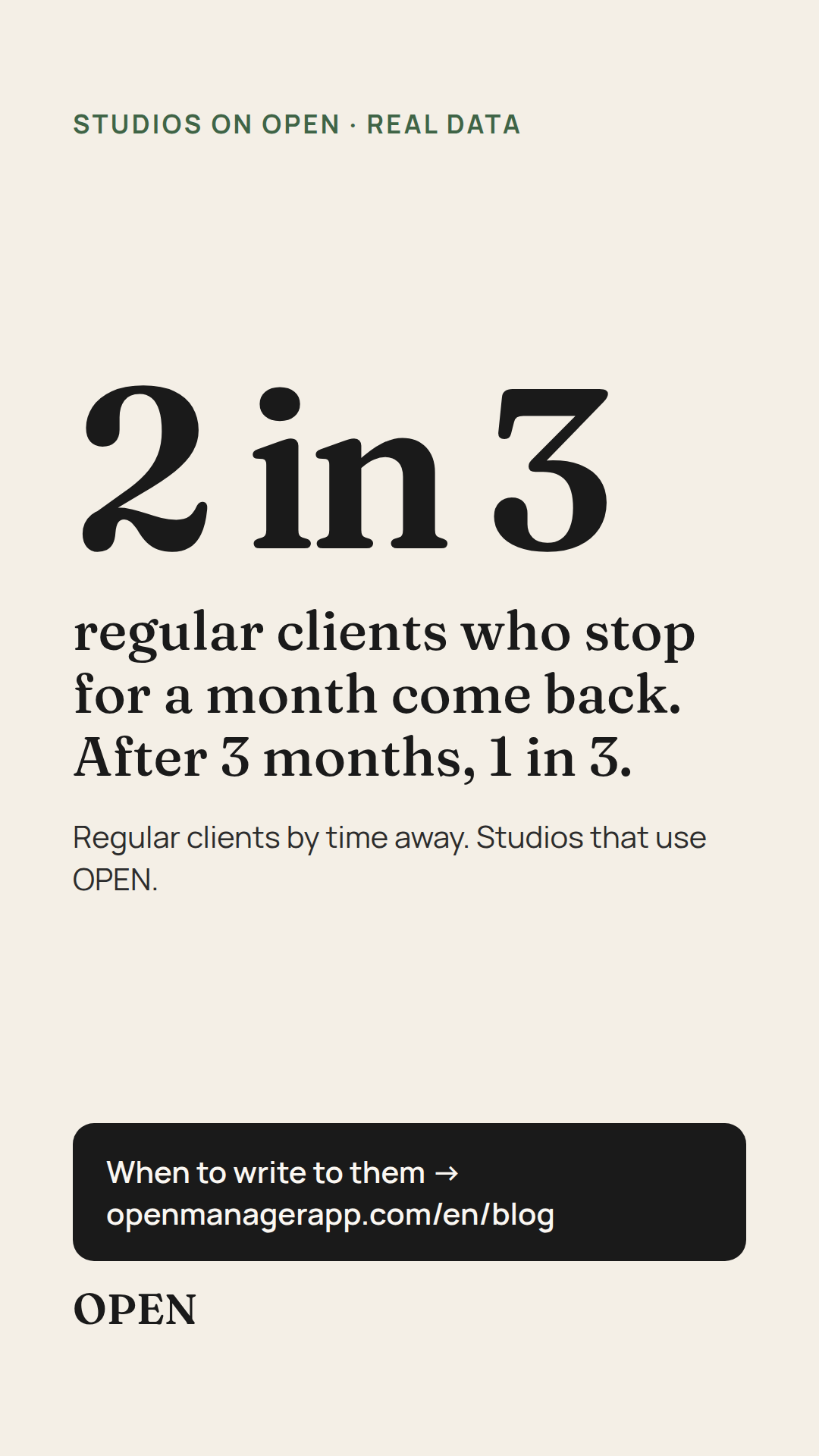
- Of regular clients who stop coming for a month, two in three come back at some point in the following year.
- After two months away it is fewer than half. After three months, one in three. After six months, one in six.
- So the best time to write is three or four weeks after their last class, not when you notice in spring.
- People who stop in June or July come back most often (three in four). People who stop in October come back least (one in two).
Data from studios that use OPEN. How we worked it out is at the end.
In this article
Every studio has them. Someone who came every Tuesday and Thursday, and then just didn't. No message, no cancellation. Most owners notice weeks later, looking at a class list and wondering where Laura went.
We wanted to know how long a studio has before that person is really gone. So we looked at regular clients at studios that use OPEN: people who came at least four times in three months and then stopped for a month or more. Then we checked who came back, and when.
How many regular clients come back
| 1 month | 67 |
|---|---|
| 2 months | 46 |
| 3 months | 35 |
| 4 months | 26 |
| 6 months | 17 |
Two in three come back. That sounds reassuring until you look at what happens next. After two months away, fewer than half return. After three months, one in three. After six months, one in six.
Put another way: every month someone stays away, their chance of coming back drops by about a quarter. The first few weeks are when a short message can still reach someone who is only half gone.
It isn't only the occasional visitors. Of the people who had come twelve times or more in three months, about three in ten who then stopped for a month never came back.
The month they stop matters
Stopping in June or July usually means a holiday: three in four of those people came back. December and January were similar, about seven in ten.
October is different. Only about half of the people who stopped then came back. March was low too, about six in ten. When everyone else is back from the summer and someone still isn't, they are more likely to be leaving.
These monthly figures cover one year, so treat them as a guide rather than a rule. The main point holds: a missed August is rarely a goodbye, a missed October more often is.
When to write, and what to say
A month is a good rule of thumb for someone who came every week. If they came twice a week, three weeks without them is already unusual. What we would write, and how:
- Write as yourself, and keep it short. "Hi Laura, we've missed you on Tuesdays. All good?" is easier to answer than a newsletter.
- Ask, don't sell. A question gets an answer, and the answer tells you what happened: a new work schedule, an injury, money, a move. Some of those you can fix, with another class time or a pause on the membership.
- Keep discounts out of the first message. Offering money straight away says the class is worth less. If they tell you it's the price, that's the moment.
- Once is enough. If there is no reply, leave it. One note bothers nobody; three do.
- Wait until after the holidays. Someone who stopped in July will probably be back in September without a message.
Noticing in time
The hard part isn't writing the message. It's noticing in time. If you take attendance, a list every Monday of people who came regularly and haven't been for a month does most of the work. From a spreadsheet, that takes some sorting. In OPEN it's a page: it shows your regular clients who have stopped coming, how long they've been away, and a short note you can edit and send.
How we worked it out
- Who we looked at. Studios that use OPEN and marked attendance every month from September 2024 to October 2026. A regular client is someone who attended at least four classes at the studio in the 90 days up to their last class. They stopped if they then had no class at that studio for 30 days or more.
- Coming back. Came back means attending a class at the same studio again within a year of that last class. We counted stops between December 2024 and October 2025, so everyone had at least a full year to come back. Someone who moved to another studio counts as not coming back.
- The figures. They combine all those studios; each one adds many stops, and no studio is named or can be identified. Studio by studio, the share who came back after a month away ranged from about four in ten to three in four.
- Messages. OPEN's notes to clients who stop coming didn't exist yet in that period, so these figures show what happens without them. Some studios may have written to their clients in other ways; we can't see that.
Get the next article
One a month, for people who run a studio. No ads.
We make OPEN, booking software for studios. If you'd like to see which of your clients have gone quiet, book half an hour with us.