
The short answer
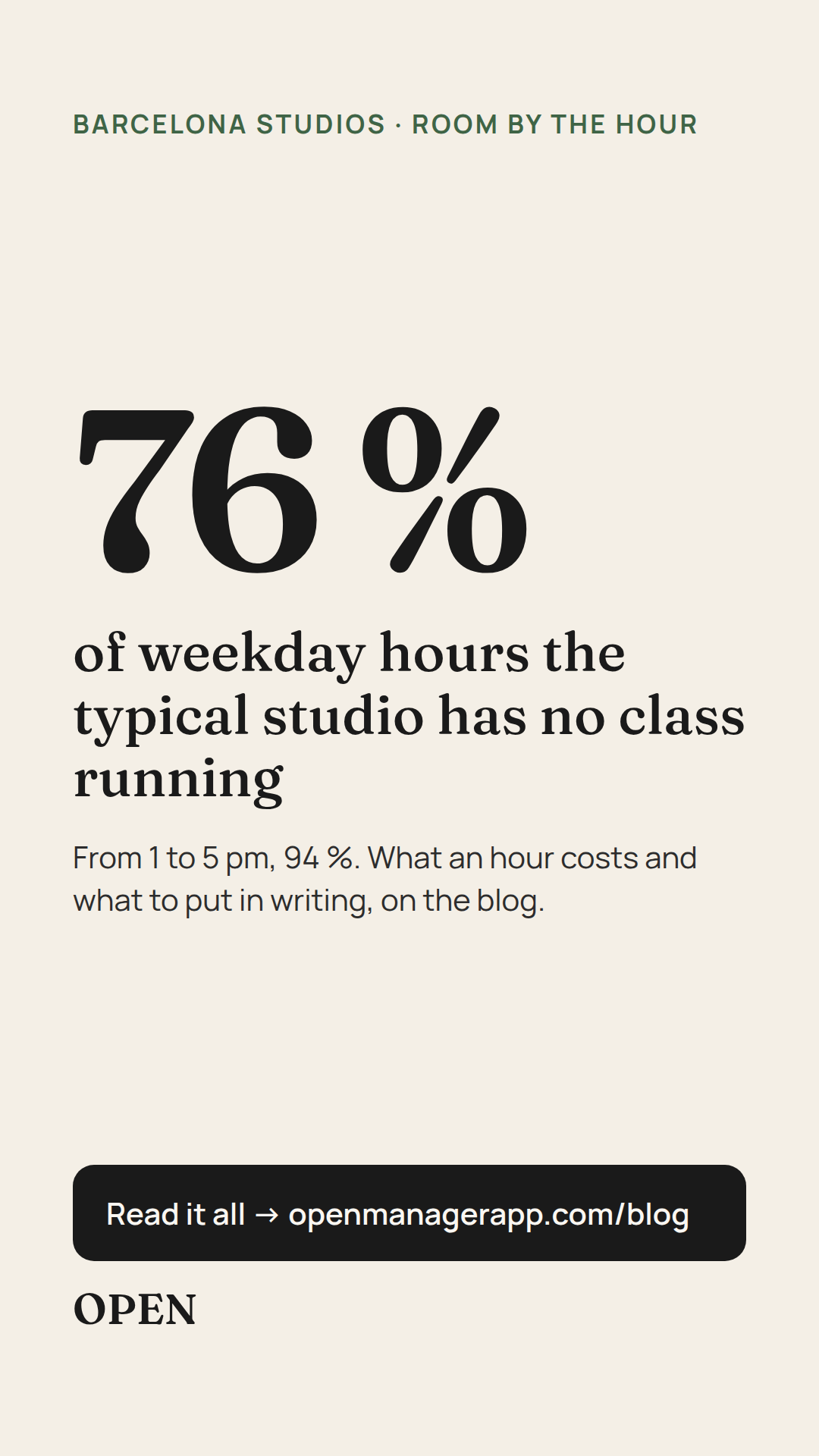
- On weekdays between 7 am and 10 pm, the typical studio has no class running 76 % of the time. Between 1 and 5 pm it's 94 %. Monday to Thursday evenings are the only really busy stretch.
- Studio rooms advertised by the hour in Barcelona cost €22 an hour at the median, and most between €18 and €25. Evenings cost about 40 % more, and a fixed weekly slot usually less.
- Work out your floor first: what the room costs you per open hour, plus heating, light and cleaning. Then price against the market, not against your own drop-in.
- Put it in writing, even on one page: the slot, the price and VAT, cancellations on both sides, August, keys, cleaning, insurance and whose clients they are.
- Renting out a room normally carries 21 % VAT. Whether the teacher also withholds 19 % depends on what comes with the room and how much she pays you in a year.
Class data from studios in and around Barcelona that use OPEN, October 2025 to June 2026. Prices from public listings read on 27 October 2026. How I worked it out, at the end. General information checked on 27 October 2026, not legal or tax advice. Ask your gestoría or lawyer to review your case before you sign anything.
In this article
I'm Nik and I make OPEN, the booking software several Barcelona studios use. When I look at a studio's timetable, the thing that jumps out is how much of the week the room just sits there. Rent is paid by the month, not by the class.
Renting your room by the hour to other teachers is the obvious way to use those hours. Plenty of Barcelona studios already do it, often with a WhatsApp message and a spare key. This post is about doing it on purpose: which hours you actually have, what to charge, and what to agree so it doesn't go wrong in March.
Renting out one room for one hour a week can look like very little money for a lot of hassle. Organised properly, it can pay the electricity bill and bring new people to the studio.
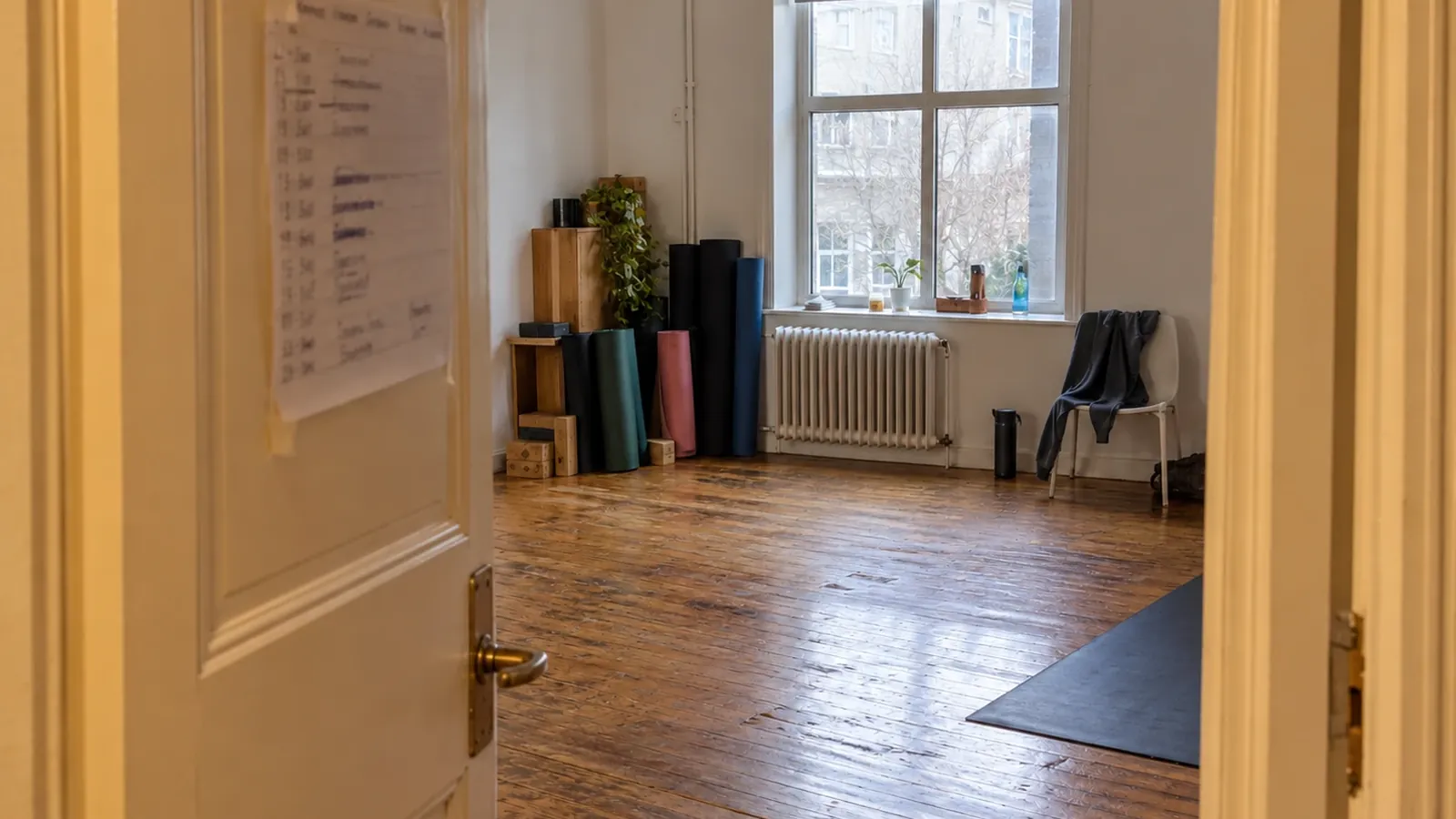
How much of the week your room is empty
I looked at the timetables of studios in and around Barcelona that use OPEN, in normal weeks of the school year (no August, no Christmas). For each half hour of the week I checked how often any class was running.
| When | No class running |
|---|---|
| Weekdays, 7 to 10 am | 85 % |
| Weekdays, 10 am to 1 pm | 81 % |
| Weekdays, 1 to 5 pm | 94 % |
| Monday to Thursday, 5 to 9 pm | 38 % |
| Friday, 5 to 9 pm | 77 % |
| Weekdays, 9 to 10 pm | 96 % |
| Saturday morning | 80 % |
| Saturday afternoon and Sunday | almost 100 % |
Across the whole weekday, 7 am to 10 pm, the typical studio has a class on for about 18 of the 75 hours. About 50 weekday hours a week are usually free (no class in at least three weeks out of four) in blocks of an hour and a half or more. Around 30 of the free hours fall between 10 am and 5 pm.
Two caveats. This counts the studio, not each room: in a studio with two rooms, each room is empty even more often. And anything that isn't on the timetable in OPEN (private sessions, rentals that already happen) doesn't show up.
It also matches what I found about bookings: only 7.5 % of bookings at the typical studio are for classes that start between 1 and 5 pm. Those are the hours worth renting.
What a room costs per hour in Barcelona
I collected more than 30 public listings of studio rooms offered by the hour in Barcelona: yoga and pilates studios, dance schools, and multi-use rooms for therapies and workshops. Some are on the studios' own websites, others on booking sites like SpacesON, CompartirEspacios, Venuu and Peerspace. I read every price on the listing itself on 27 October 2026.
| Listings | Per hour |
|---|---|
| Median | €22 |
| Middle half of listings | €18 to €25 |
| Small rooms (up to about 40 m² or 10 people) | €20 |
| Larger rooms | €22.50 |
| Cheapest and dearest | €7.50 to €80 |
The extremes are special cases: the cheapest is a small room in Sants sold only in two-hour blocks, the dearest a room offered only at weekends on a booking platform. The most common price is a round €25.
What else the listings show:
- The time of day sets the price. Weekday mornings and midday are the cheapest. Where a listing has an evening price (usually from 5 or 6 pm), it's about 40 % higher. Weekends about 30 % higher. Some studios only rent the hours their own classes leave free.
- Regular slots are cheaper. Where a discount is given for a fixed weekly slot or a pack of hours, it's usually between 10 % and 30 %. Some studios sell "one class a week" as a monthly price, around €100 to €110.
- VAT is a mess. Most listings don't say whether VAT is included. Ask, because it's 21 % (more on that below).
- Ask what's included: mats, props, a sound system, cleaning. Listings vary and many don't say. Cleaning is rarely included.
- Hardly any listing says what happens if someone cancels, and none of the studio pages I read asked the renter for insurance. That's exactly what to sort out in writing.
How to price your hour
I'd do it in three steps.
1. Your floor. Divide the monthly rent by the hours the studio could open. At the city's average shop rent (€19.57 per m² a month in 2025, Ajuntament survey), a 70 m² space costs about €1,370 a month. Spread over weekday hours from 7 am to 10 pm, about 325 a month, that's roughly €4.20 per hour. Then add what an extra hour really costs you: heating or air conditioning, light, cleaning, wear on the mats. The rent is paid anyway, so anything above that extra cost brings money in. Pricing at least at the rent share plus the extra cost makes each rented hour pay its part of the space.
2. The market. Then look at what rooms like yours go for: size, floor, light, sound system, changing room, how central. For an ordinary yoga or pilates room, the listings above put the hour at around €20 to €25 during the day. A bigger room, a sprung dance floor or a very central street can ask more.
3. Compare it with a class. A midday class with three people brings in about €32 at what people really pay per class (about €10.80), before you pay the teacher. An hour rented at the market rate, with no teacher to pay, often leaves more. That doesn't mean you should cancel the class. It means a quiet slot isn't automatically worth keeping.
A few habits from the listings that I think are worth copying:
- A lower price for a fixed weekly slot, paid by the month. You get a regular income and the teacher gets her slot every week.
- A higher price for evenings and weekends, or simply not renting Monday to Thursday after 5 pm. Those are your own best hours.
- Paid in advance: by the month for regular slots, when booking for one-offs.
- The setup and cleaning time inside the slot, or charged as part of it. A 60-minute class needs at least 75 minutes of room.
One more question before the price: who do you want in your room? A teacher who does something you don't offer (pilates if you're a yoga studio, a children's class, a therapy, a workshop) brings new people through your door. A teacher running the same class as yours, at the same time of day, at a lower price, is competing with you from inside your own room.
What to put in writing
Most of these arrangements start with a WhatsApp message. That's fine for a one-off workshop. For a weekly slot I'd write one page and both sign it. It doesn't need to be a lawyer's contract, but it should answer what will otherwise turn into an argument:
- The slot and the price. Day, time, from when, how much, whether VAT is on top, how and when it's paid.
- Cancellations, both ways. How much notice the teacher gives to drop a session without paying, and what happens if you need the room (a workshop of yours, a repair). The few listings that say anything go from no refund at all to a full refund with a month's notice. For a weekly slot I'd ask for 48 hours.
- Holidays and August. Does the slot continue in August, or pause? Bank holidays? Write it down; this is where most disagreements start.
- Keys and access. Who has a key, the alarm code, who locks up, what happens if a key is lost.
- The room. Maximum number of people, music and noise (neighbours), what equipment she can use, how the room is left, who cleans.
- Insurance. She has her own civil liability insurance for her classes and sends you the certificate. Check what your policy covers when someone else is teaching in your room.
- Notice to end it. A month either way is common for a regular slot.
Whose clients are they
This is the part people skip. If the teacher rents your room, her clients are her clients: she takes the bookings, she charges them, she invoices them. Agree that you won't contact her clients to sell them your classes, and that she won't use your client list either.
If instead you take the bookings and payments for her classes through your studio, it isn't really a rental any more. It's closer to a class at your studio with a split of the income. Then her clients' data passes through you, and data protection law expects you to agree in writing who is responsible for it and how you handle it (GDPR arts. 26 and 28). Pick one model and keep to it.
And the opposite case: if the "renter" works to your timetable, at your prices, with your clients, and you pay her, that's not a rental either. A gestoría would look at how the relationship really works, and so would a labour inspector, as I wrote about hiring teachers.
In OPEN, I'd put a rented slot on the timetable as a class in that room with "Public class" turned off. Your clients don't see it and nobody books something else on top of it.
Tax, lease and licence
General information only. Ask your gestoría how it applies to you before the first invoice.
VAT on the room
Renting out a room, by the hour or by the month, normally carries 21 % VAT. The exemption in the VAT law covers only housing (Ley 37/1992, art. 20.Uno.23 and art. 90), and Hacienda has applied the general rate to premises rented by the hour (DGT ruling V2391-21). So a €20 hour is €24.20 with VAT. If you advertise €20 "all in", you keep €16.53.
Renting space by the hour is also an activity of its own for tax purposes, with its own business-tax heading (DGT V2675-17). Most small studios don't pay that tax, but the heading still goes on your tax registration. If you're self-employed rather than a company, also ask how the rental income goes in your income tax. Tell your gestoría before the first invoice.
Does the teacher withhold 19 %?
This is the fuzzy part. A teacher who rents as a business, self-employed or through her own company, normally withholds 19 % of the rent before VAT and pays it to Hacienda every quarter (RD 439/2007, arts. 75, 76 and 100). That holds whether your studio is a person or a company, and mats and cleaning don't change it. When the room also comes with real services like reception and bookings, Hacienda has treated it as a mix of rent and services, with no withholding (V3148-18, V0618-21). There's also no withholding if she pays you €900 a year or less.
So a bare room usually means withholding, and a room with reception and bookings may not. Write down what's included, and have both gestorías agree on which case it is.
VAT on her classes
The teacher invoices her own clients. Ordinary yoga and pilates classes normally carry 21 % VAT (V2955-23). Some dance teaching can be exempt, depending on the subject and who teaches it (V0387-26). Her clients, as private people, don't withhold anything.
Your own lease
If you rent your premises, read the lease first. When the lease says nothing, the law lets a business tenant sublet part of the premises without the landlord's consent, but you must tell the landlord in a provable way within a month, and they can raise the rent by 10 % (LAU art. 32). Many commercial leases forbid subletting, and the lease comes first. Whether hourly use is a sublet at all isn't clearly settled. Ask before you start, not after.
Licence and insurance
Your activity notification is for what happens in your premises. A teacher running a class like yours shouldn't change much, but a different activity might. Health uses like physiotherapy need their own authorisation from the Generalitat's Health Department. Check with the Ajuntament or your technician before you say yes to one.
In Catalonia, whoever organises a sports activity needs civil liability cover of at least €600,000 per claim and €150,000 per victim (Decree 58/2010), and sports professionals who aren't only employees need their own policy (Llei 3/2008). The Diputació's guidance for municipal sports facilities uses a yoga class as an example where the teacher needs her own policy (Diputació de Barcelona). I'd ask the teacher for her policy and ask your insurer what yours covers when someone else teaches in your room.
Strict rules about hours and access are crucial. We once had to help a studio move to a new location after it lost its lease, because a teacher it sublet to used her access to throw a late-night kirtan.
If you're the teacher who rents
- Ask for the price with and without VAT, and whether the setup time is included.
- Get the slot, the cancellation rule and August in writing before you start promoting your class.
- Have your own liability insurance, and ask whether the studio wants to see it.
- Check the room at the time you'll use it: the light, the noise from the street, what's in the cupboard, where people change.
- Your clients are yours. Take their bookings and payments yourself, unless you've agreed otherwise in writing.
How I worked it out
- Empty hours. Timetables of studios in and around Barcelona that use OPEN, in normal weeks from October 2025 to June 2026 (weeks with far fewer classes than usual, like Christmas, are left out). For each half hour from 7 am to 10 pm I counted how often any class was running. Each figure is the median studio (the one in the middle) and combines at least five studios. No studio is named or identifiable.
- It counts the whole studio, not each room, so for studios with more than one room the empty share is a minimum. Classes, privates or rentals not entered in OPEN, and online classes and events, are not included.
- Prices. More than 30 public listings of studio rooms offered by the hour in Barcelona city, on studios' own websites and on booking sites, read on 27 October 2026. For each I took the advertised price of one hour in the standard room (the smallest room set up for classes), at the cheapest time of day. Therapy cabins and event venues are left out. These are asking prices, not what was actually paid, and most listings don't say whether VAT is included.
- Rent per hour. The Ajuntament's survey of rent paid by shops, city average for 2025. It covers shops, not studios, and includes old contracts, so take the example as a rough guide.
- Law and tax. Checked on 27 October 2026 against the sources linked in the text.
Get the next article
One a month, for people who run a studio. No ads.
I make OPEN, booking software for studios. If you're thinking about renting out your empty hours and want to talk it through, book half an hour with me.